
How to create a COA for crypto
This guide outlines best practices for creating a chart of accounts that represents your crypto business. These practices may differ by region. Always consult with your company accountant or tax advisor on financial processes.
NOTICE: FASB now requires specific tracking of digital assets. See the FASB guidelines from KPMG for more details.
Customer Integral's Chart of Acounts template for a Quickstart: Default COA Template.csv
What is a Chart of Accounts?
A Chart of Accounts is a categorized ledger of all your business activities. It is composed of many financial categories (referred to as “ledgers” by accountants): Assets that you hold, Income that you earn, and Expenses that you spend. Some companies will also have a Cost of Goods Sold category.
Categorizing your transactions according to a Chart of Accounts will give you a picture of your business’ financial health.
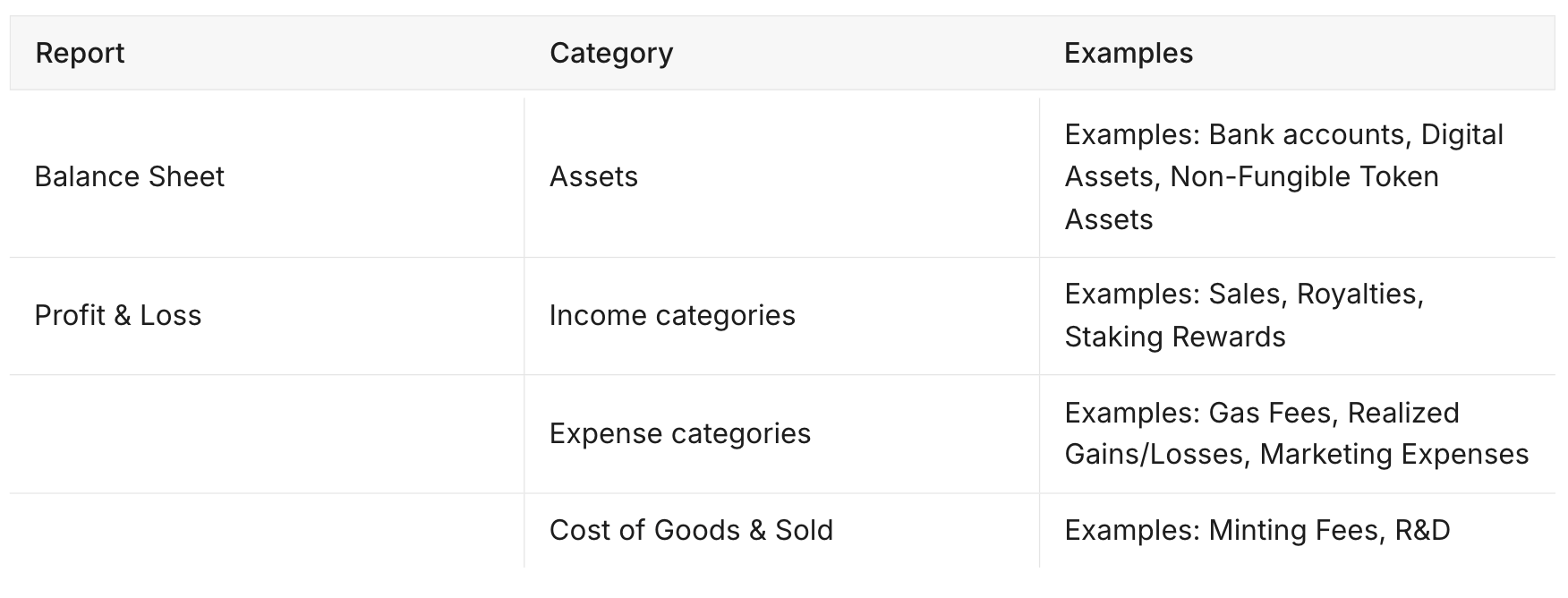
How to set up a GAAP-compliant Chart of Accounts for crypto
To best represent your crypto activity in Integral, you will need four types of accounts:
Intangible Asset accounts for all your crypto assets (wallets, tokens, and NFTs)
An Expense or COGS account for your Gas Fees
An Expense account for your Realized Gains & Losses
An Expense account for your Unrealized Gains & Losses
How to set up your Intangible Asset accounts
Please consult an accountant when creating your Chart of Accounts
Option #1: Bundled into Digital Assets
In the US, GAAP standards require crypto companies to record all their crypto assets as intangible assets. This may be different in other regions. For this reason, you might see crypto assets bundled into a single “Digital Assets” or “Intangible Assets” account (regardless of how many wallets or tokens you hold).
This is compliant and legally correct. It’s a good solution for companies where crypto is a small portion of their business. However, for companies where crypto is their core business, this might not provide sufficient granularity to understand the financial health of your company.
Option #2: Categorized by Token
Typically seen by: Companies with many tokens, Bounty Marketplaces, DEX, DeFi platforms
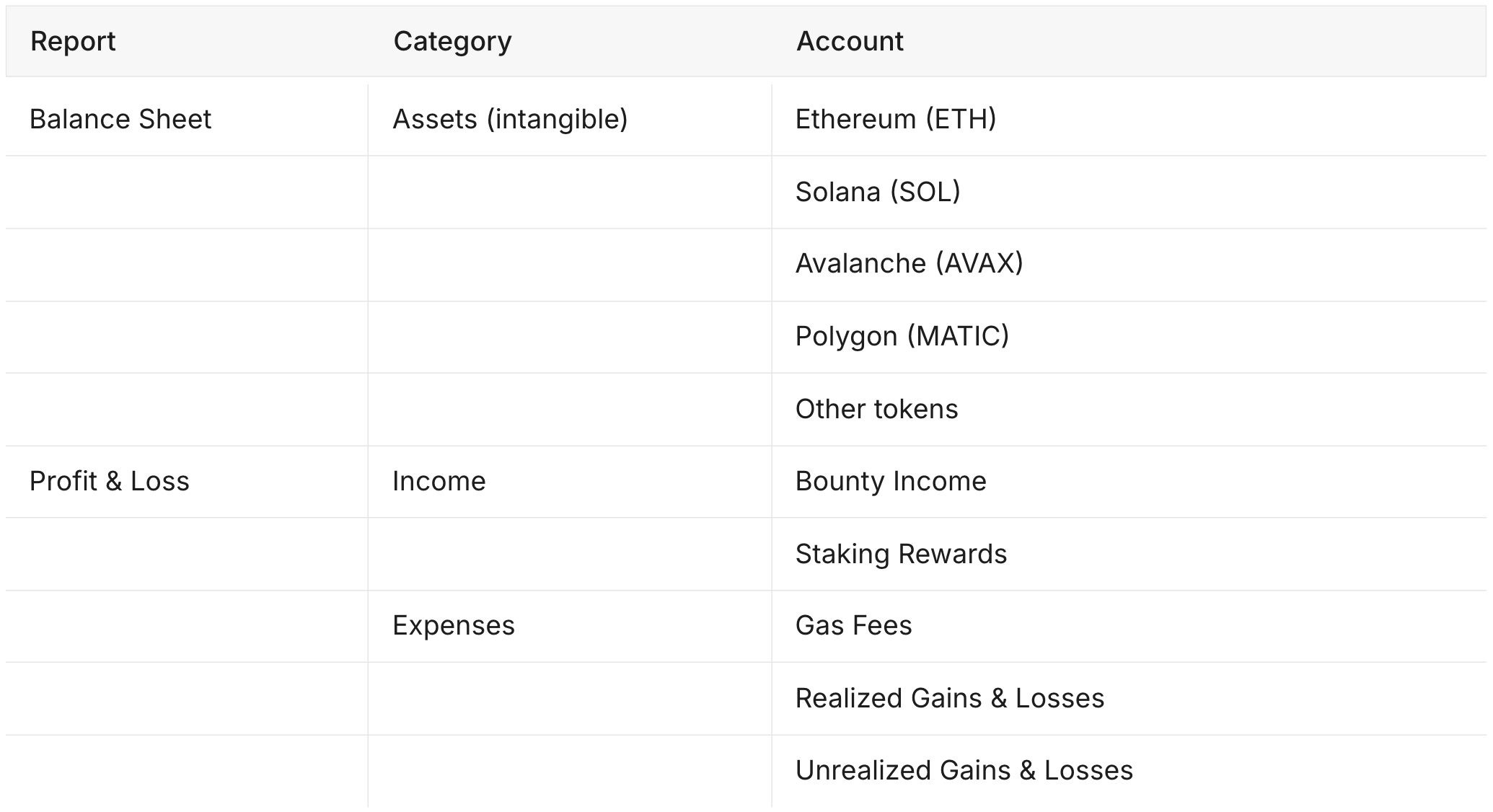
For treasury-oriented crypto companies that operate across multiple chains, earn income in different tokens, and conduct DeFi activity, it usually makes sense to have asset categories for each major token held.
For a Bounty Marketplace, a very simple Chart of Accounts might look something like:
Option #3: Categorized by Wallet
Typically seen by: NFT Collections, Creator Marketplaces
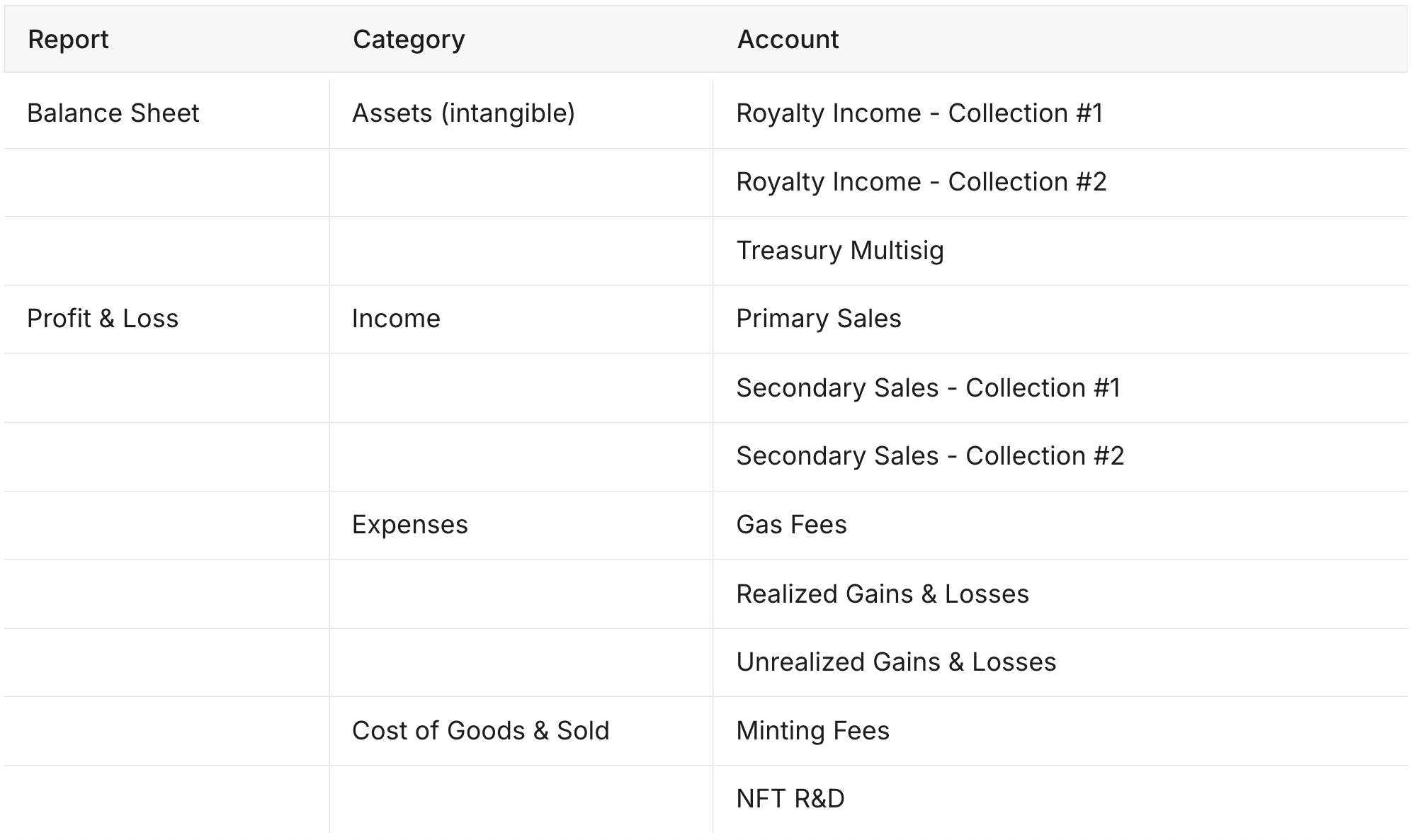
For operations-oriented crypto companies that have wallets tied to specific activities like royalty income, payments, and other operations, it may make sense to have intangible asset categories for each wallet.
For an NFT company, a very simple Chart of Accounts might look something like:
Set yourself up for success with Integral
Integral gives you full flexibility to set up your Chart of Accounts in the way that best reflects your business. Simply map your wallets and tokens to the appropriate asset accounts in the Chart of Accounts page. If you need help, follow the instructions here.
And of course - say hi to get started! 👋